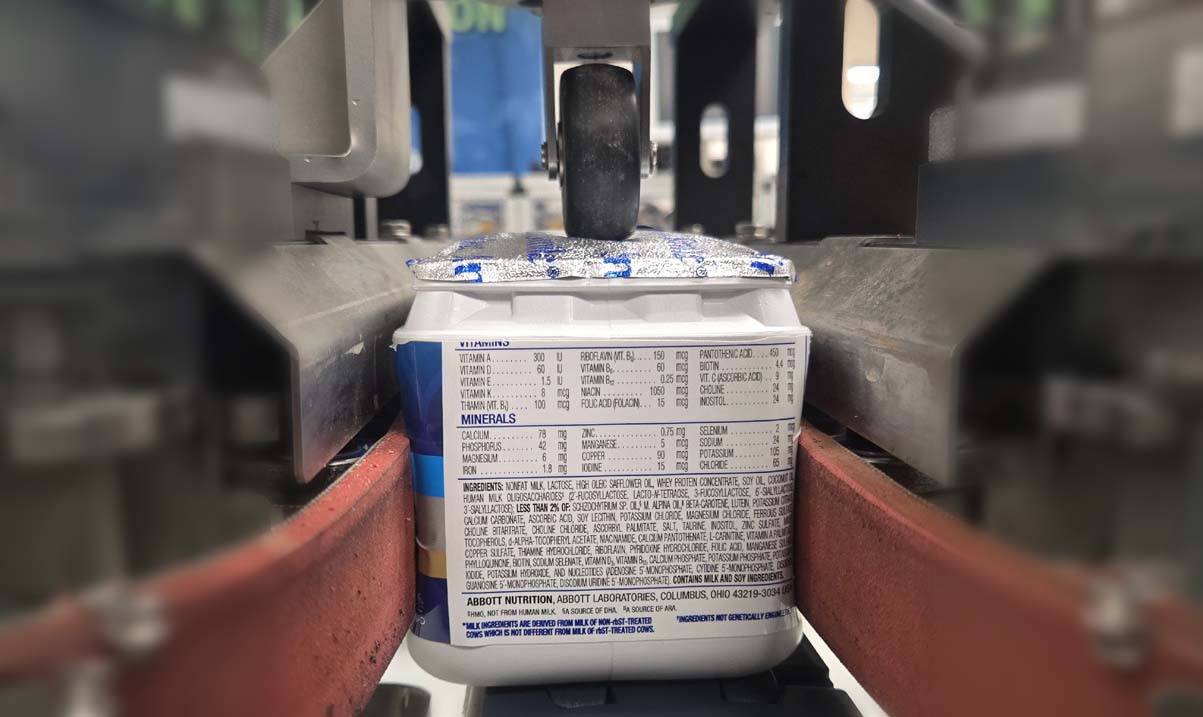
Tested: Plastic Tubs with foil for Seal Integrity
Inspection Requested: The purpose of this test was to demonstrate the effectiveness of the TapTone system in evaluating seal integrity on powdered formula in plastic tubs sealed with foil lids. Traditional inspection methods—such as periodic spot checks—can interrupt production and increase downtime. In contrast, the TapTone T550‑C‑TDLC provides continuous, in‑line inspection at full production speeds, ensuring that only properly sealed containers reach the customer. The system is capable of inspecting both wet and dry products, making it a versatile solution for a wide range of production environments. This evaluation confirms that TapTone technology can reliably detect seal defects and support consistent quality control on modern packaging lines.
TapTone Equipment Used: TapTone T550‑Compression with Top‑Down Load Cell (TDLC)
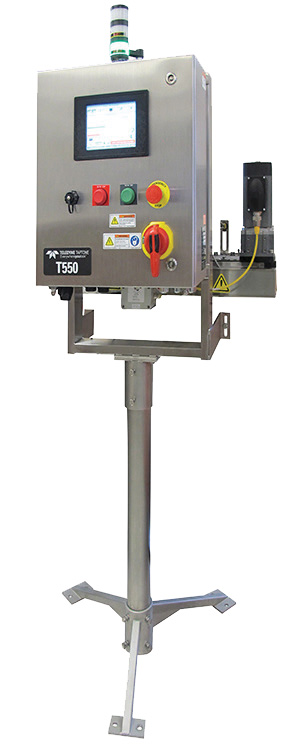
Compression Technology ‑ detects leaks in plastic containers. As a container passes through the system, dual parallel belts apply force to the sidewalls of the container. This action compresses the headspace of the container, which allows a sensor to take a force measurement on the bulging headspace at the discharge of the system utilizing DSP technology, the controller analyzes the measurement and assigns a merit value* to each container. If the merit value is outside of the acceptable range, a reject signal activates a remote reject system.
Top‑Down Load Cell (TDLC) Sensor: By squeezing the container sides to create head pressure, this domes the foil or plastic seal which permits measurement of load cell merit values from above. This innovative TapTone design takes product inspection to a new level by offering customers the ability to meet the demand of leak detection in smaller, low profile style products.
Testing
Testing began by removing the lids from (5) 20.6oz tubs. (1) container had its seal partially broken, and (1) container was given a precision drilled (0.025”) hole. All 5 containers were then run through the T550‑C‑TDLC (5) times. ‑ The top down load cell was callibrated at 4lbs. A loop conveyor was used running at 75ft/min.
Results
As shown in the Force Merit Value graph above, the T550‑C‑TDLC system consistently distinguished between leaking and improperly sealed containers. A separation of more than 100 merit values between properly sealed containers and those with small holes demonstrates strong accuracy and repeatability. Containers with fully broken seals generated an even larger deviation, ensuring they are reliably detected and rejected by the system.
Notes: Vacuum Effect: Because the containers were under vacuum during inspection, larger holes were required for detection by the load cell. Under normal line conditions without vacuum, the system is likely capable of identifying significantly smaller leaks.
Seal Behavior: For accurate testing, line conditions must allow the foil seal to rise slightly above the tub lip when the sidewalls are gently squeezed. (Refer to images above for examples under the load cell.)
*Merit value is a calculated number determined using an algorithm to compute a resultant from a set of data values. The algorithm for the T550-C is Force.
Test results achieved in the test laboratory may be different from results seen in the production environment.

