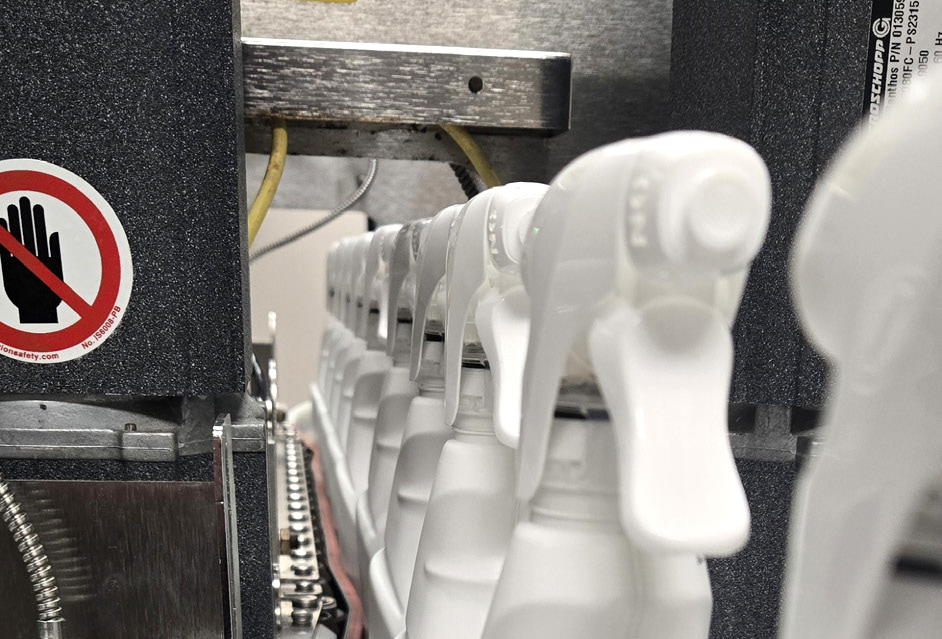
Tested: 32 FL OZ HDPE Trigger Bottles
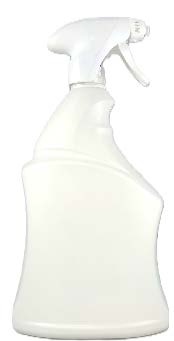 Inspection Requested:
Convenience packaging using trigger spray bottles has long been a staple in household and industrial products. However, irregularities in the extrusion blow molding process can lead to improper seals between the bottle neck and the trigger cap. This poses a challenge for Consumer Packaged Goods (CPG) companies, as inconsistencies in seal compression and actuator fit can be difficult to detect using traditional inspection methods.
This test demonstrated the effectiveness of TapTone’s DSC in detecting seal integrity issues in plastic bottles with trigger caps. Faulty seals can lead to contamination, spoilage, and health risks. The DSC system identifies these defects early, ensuring compromised bottles are rejected before reaching consumers.
TapTone Equipment Used: TapTone PRO-Series DSC
Technology corner - How it works
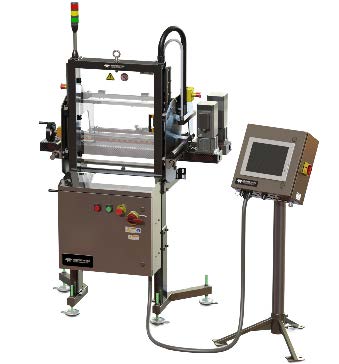 TapTone’s Dual Sensor Compression (DSC) system is designed to detect and reject leaking or damaged flexible bottles—such as those with trigger caps— at production line speeds up to 250 feet per minute. The system features dual parallel compression belts mounted above the customer’s existing conveyor. As each container passes through, the belts apply force to the sidewalls, compressing the headspace and enabling comparative measurements at both the infeed and discharge points. This self-referential comparison eliminates common production variables like fill level, temperature, and container density. Using advanced DSP technology, the system assigns a merit value to each container; if the value falls outside the acceptable range, a reject signal is triggered to remove the defective bottle from the line.
Neck deformity (tooling gouge/burr)
Trigger bottles in dsc belts
Testing Summary
In a series of tests, HDPE trigger spray bottles were evaluated using TapTone’s Dual Sensor Compression (DSC) system to assess its effectiveness in detecting seal leaks at the cap interface. Flat belts were used during testing. The test included eight properly sealed containers, two natural leakers with deformation in the neck/trigger seal, one container with a precision-drilled 0.04” hole, and one with a 0.02” hole. Each container was run through the PROS-DSC system ten times at a line speed of 75 feet per minute roughly equivalent to 180 containers per minute.
Precision drilled 0.02”/0.04” holes
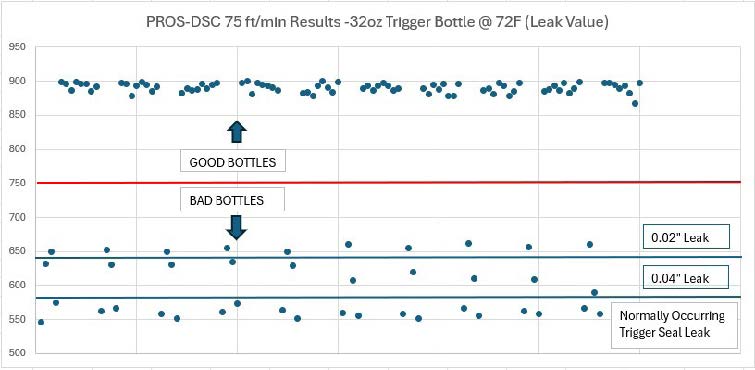
The red line is to show a low reject limit of 750 merit value
Testing results
Based on the results, the PROS-DSC system clearly distinguishes between properly sealed and leaking containers. Naturally occurring leaks were easily identified, as well as leaks as small as 0.02”. Leaking containers consistently received merit values roughly 300 units lower than good containers, providing strong reject confidence even with wide population variation. Smaller leaks still showed a difference of over 200 units. Given the large gap between good and bad containers, there’s room for smaller leaks to be found. These results highlight the DSC system’s exceptional resolution and reliability for this container type.
*Merit value is a calculated number determined using an algorithm to compute a resultant from a set of data values. Depending on the application, the most effective merit value will be used to reject “bad” containers. Algorithms for the DSC Sensor include Entry, Exit, and Leak.

