
Tested: Plastic Containers with Aluminum Foil Seals
Inspection Requested: The purpose of this test was to demonstrate the effectiveness of the TapTone DSC Sensor in detecting seal integrity of plastic containers with aluminum foil seals. Poor seal integrity can create a point of entry for contamination, leading to product spoilage and potential health risks for consumers.
The DSC Sensor is specifically designed to identify compromised seals in non-pressurized plastic bottles and containers before they leave the production facility, ensuring product safety and quality.
TapTone Equipment Used: TapTone Dual Sensor Compression (DSC)
How it works
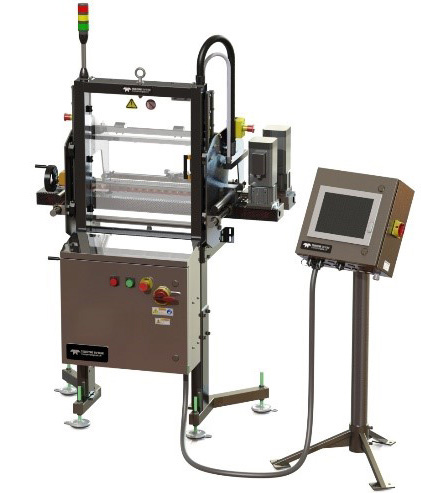 The Dual Sensor Compression system finds and rejects leaking and damaged flexible bottles at production line speeds up to 250 feet per minute. The system is designed with dual parallel belts suspended over the customers’ existing conveying system.
As the container passes through the system, the dual parallel belts apply force to the sidewall of the container. This action compresses the headspace of the container which allows a comparative measurement to be taken at both the infeed and the discharge of the system. Comparing the container to itself between the infeed and discharge of the system eliminates typical variations seen in the production environment (Fill Level, Product Temperature, and Container Density).
Utilizing proprietary DSP technology, the PRO Series user interface analyzes the comparative measurement and assigns a merit value to each container. If the merit value is outside the acceptable range, a reject signal activates a remote reject system.
Testing
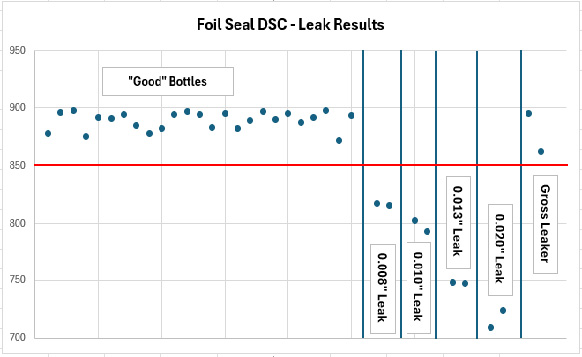
During the test, five (5) containers were used for leak and seal evaluation. In order to access the aluminum foil seal, testing was conducted with the caps of these containers removed. For this specific style of bottle, the DSC obtained the best results using beveled belts to squeeze the concaved area of the container. First, the bottles were run through the unit five (5) times each to find the average merit values of “good” non-leaking containers. Leaks were then induced in the containers by puncturing the aluminum foil seals with precision drill bits, and the leaking containers were then passed through the unit again two more times.
Results
This test determined that the DSC sensor is fully capable of detecting compromised seals in these plastic containers. Micro leaks as small as 0.008” drastically stood out using the Leak Value algorithm. As expected, gross leakers did not stand out using the Leak Value. This is where multiple user set limits becomes useful. As can be seen in the graph to the right, the gross leak is easily rejected by using Entry Merit Value.
The TapTone Dual Sensor Compression System is highly recommended for this application.
NOTE: During all testing, no visual damage to the bottle was observed.
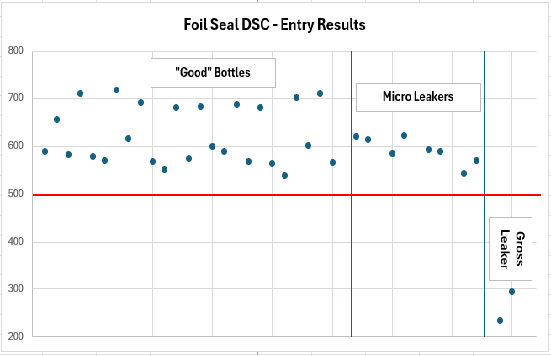
* Merit value is a calculated number determined using an algorithm to compute a resultant from a set of data values. Depending on the application, the most effective merit value will be used to reject “bad” containers. Algorithms for the Dual Sensor Compression sensor include Entry, Exit, and Leak.

