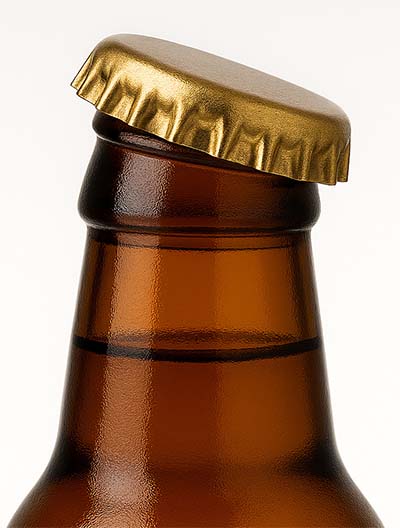
Tested: Glass Bottles with Metal Crowns
Inspection Requested: TapTone’s Acoustic Cocked Crown Sensor (ACC) is well-established in the brewing industry as the inspection system of choice in testing the seal integrity of glass beer bottles at production line speeds. The cocked crown option is a supplement to the Acoustic sensor to improve rejection of bullnose, dented, dimpled, wrinkled, crushed and cocked crowns. A small percentage of cocked crowns have the same acoustic response as a good crown making them difficult to detect. The Acoustic sensor with the Cocked Crown option is ideal for insuring that no beer bottles reach the consumer without the highest quality.
TapTone Equipment Used: TapTone Acoustic Sensor with Cocked Crown Option
How it works
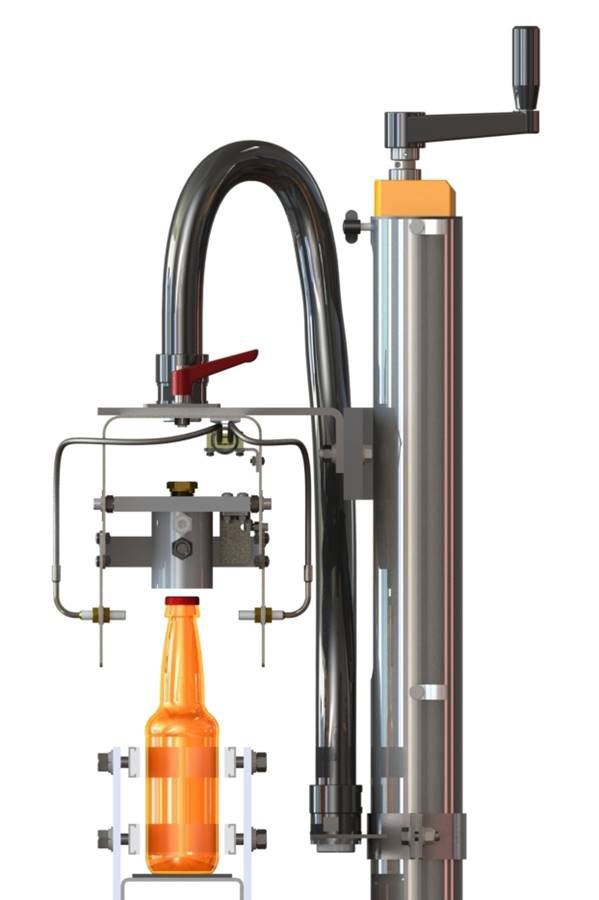 The acoustic sensor uses acoustic technology to measure pressure in bottles that do not have a measurable lid deflection. The acoustic sensor works by applying a “tap” to the top of each container. The “tap” is produced by a large electromagnetic pulse, which excites the container lid. The lid vibrates at a natural resonant frequency “tone” based on internal pressure. The resultant “tone” signal is sensed by a microphone, digitally sampled and stored in memory for processing. The Digital Signal Processor (DSP) produces a real-time signal spectrum and calculates the resultant frequency of the “tone” for that container lid. This frequency value is then compared to user set limits where containers with a frequency response outside these limits are rejected.
The cocked crown detector is an option with the acoustic sensor to increase the detection and rejection of damaged crowns. It works by measuring the crown curvature with an analog proximity sensor and comparing it to the curvature of a good crown. If the detector determines that the measured crown is outside of a predefined set of criteria, a reject signal is sent to the user interface to remove the bottle from the production line.
Testing
For this application review, three glass beer bottles with metal crowns were evaluated on a loop conveyor. One bottle was intentionally set to zero pressure, another was fitted with a cocked crown, and the third served as a properly sealed control sample. The acoustic sensor head and photo-eye triggers were adjusted according to application requirements.
Results
As shown in the data plots below, the ACC sensor clearly differentiates between all three sample types. The separation in merit values* between low-pressure and properly sealed bottles provides a reliable basis for establishing rejection thresholds. These results demonstrate that bottles with pressure loss or defective caps can be accurately identified using the TapTone ACC sensor.
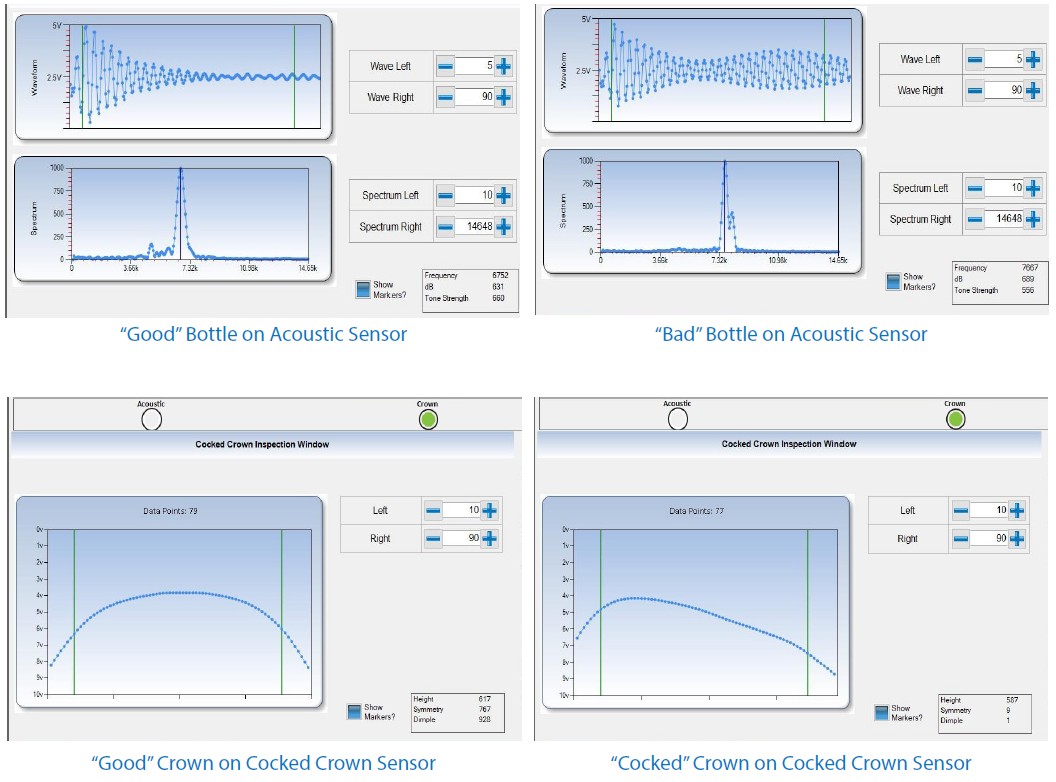
*Merit Value is a calculated number determined using an algorithm to compute a resultant from a set of data values. Depending on the application, the most effective merit value will be used to reject “bad” Containers. Algorithms for the Acoustic Sensor include Frequency, dB, and Tone Strength. Algorithms for the Cocked Crown sensor include Height, Symmetry, and Dimple.

